5 Nigerian Books That Became Movies

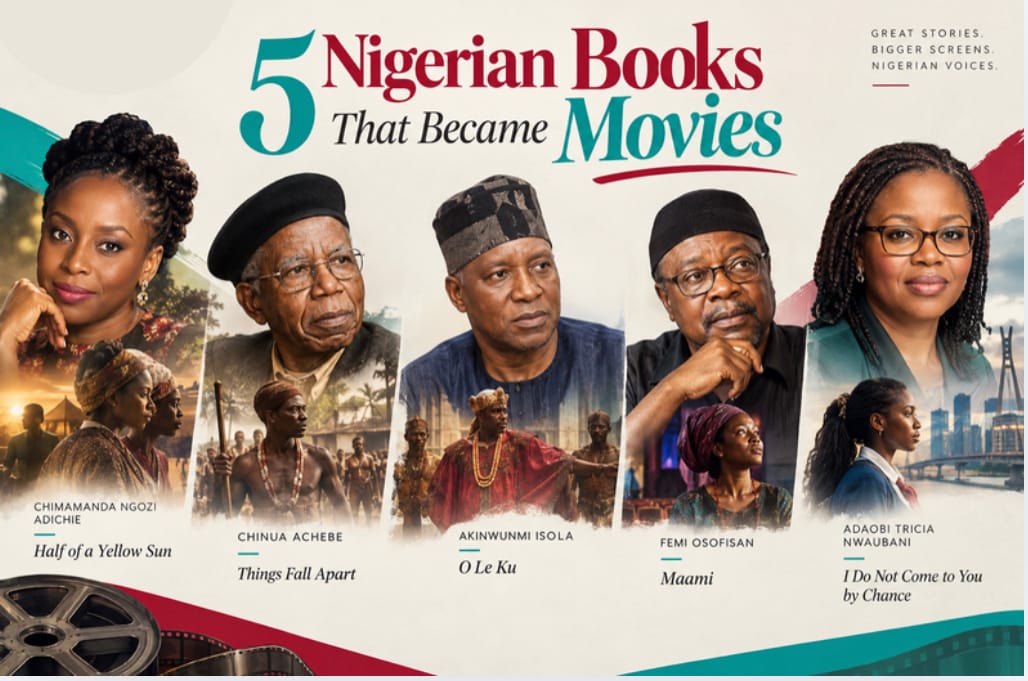
You’ve probably watched some of these movies without knowing they started as books.
Nigerian authors have given us stories about love, family, war, ambition, culture and everyday life. Some of those stories eventually moved beyond the pages and onto our screens.
From Half of a Yellow Sun to Maami, here are five Nigerian books that became movies.
1. Half of a Yellow Sun — Chimamanda Ngozi Adichie
Chimamanda Ngozi Adichie’s Half of a Yellow Sun is set during the Nigerian Civil War and follows twin sisters Olanna and Kainene, whose lives are dramatically changed by the conflict.
The novel explores love, family, privilege and survival against the backdrop of one of the most difficult periods in Nigeria’s history.
The story was adapted into a 2013 movie starring Chiwetel Ejiofor, Thandiwe Newton and John Boyega, with Biyi Bandele directing.
If you watched the movie, you already know how emotional the story gets. But the book gives you even more room to understand the characters and everything happening around them.
2. Things Fall Apart — Chinua Achebe
If you went through the Nigerian school system, chances are you’ve come across Okonkwo.
Chinua Achebe’s Things Fall Apart tells the story of Okonkwo, a respected Igbo man whose life and community are thrown into turmoil as colonialism and Christianity begin to change the society around him.
Published in 1958, the novel became one of the most widely read African works of literature.
The story has also made it to the screen, including a Nigerian television adaptation in 1987 starring Pete Edochie as Okonkwo.
It’s one of those books that shows how a story written decades ago can still feel relevant today.
3. O Le Ku — Akinwunmi Isola
Before O Le Ku became a movie, it was a popular Yoruba novel written by Akinwunmi Isola.
The story follows Ajani, a University of Ibadan student whose experiences with love and relationships lead him through a complicated journey.
The film adaptation was directed by Tunde Kelani and brought the story to a wider audience through cinema.
What makes O Le Ku interesting is the way it carries Yoruba culture, language and social experiences from the original novel onto the screen.
Sometimes, watching the movie is also a reminder of just how many Nigerian stories have been sitting in books long before we saw them on screen.
4. Maami — Femi Osofisan
Maami is a story about family, sacrifice, poverty and the bond between a mother and her child.
Femi Osofisan’s novel follows Kashimawo, a successful footballer whose memories of his childhood and his relationship with his mother remain a major part of his story.
The book was adapted into a 2011 film directed by Tunde Kelani, with Funke Akindele playing the title character.
The movie brings the emotional relationship between Maami and her son to life, while the novel gives readers more space to explore Kashimawo’s memories and experiences.
And honestly, if you’ve seen Maami, you already know this is one of those stories that can leave you reaching for tissue. 😭
5. I Do Not Come to You by Chance — Adaobi Tricia Nwaubani
This one feels particularly familiar because it deals with issues many young Nigerians can recognise.
Adaobi Tricia Nwaubani’s I Do Not Come to You by Chance follows Kingsley, a university graduate struggling to find work while facing pressure to provide for his family.
Then his uncle introduces him to a world of quick money and internet fraud.
The novel explores unemployment, family expectations, ambition, money and the difficult choices people can face when they desperately want a better life.
The book was adapted into a 2023 film directed by Ishaya Bako.
It’s a good example of how Nigerian books can tackle very current social issues while still telling an entertaining story.
From Books to Movies
A good book gives filmmakers something valuable: a story that already has characters, conflict and a world readers have connected with.
But when that story moves to the screen, we get to experience it differently.
We hear the characters speak. We see the locations. We watch the relationships unfold in front of us.
And sometimes, the movie introduces people to a book they might never have picked up otherwise.
So the next time you watch a Nigerian movie that leaves you thinking, “This story is too good,” there’s a chance you can find an even bigger version of that story between the pages.
Have you read any of these books, or did you watch the movie first?