Nigerian Authors That Made Us Fall in Love With Nigerian Stories

There is something special about reading a story that feels familiar.
The names may be different, the characters may live in another generation, and the setting may be miles away from where we are today but somehow, you recognise the people, the humour, the struggles, the family dynamics and the realities of life.
That is the magic Nigerian authors have given us.
Over the years, Nigerian writers have taken our stories beyond our communities and introduced readers around the world to the complexity, beauty and contradictions of Nigerian life. From village traditions and colonial encounters to identity, migration, family, politics and womanhood, they have given us stories that entertain us while making us think.
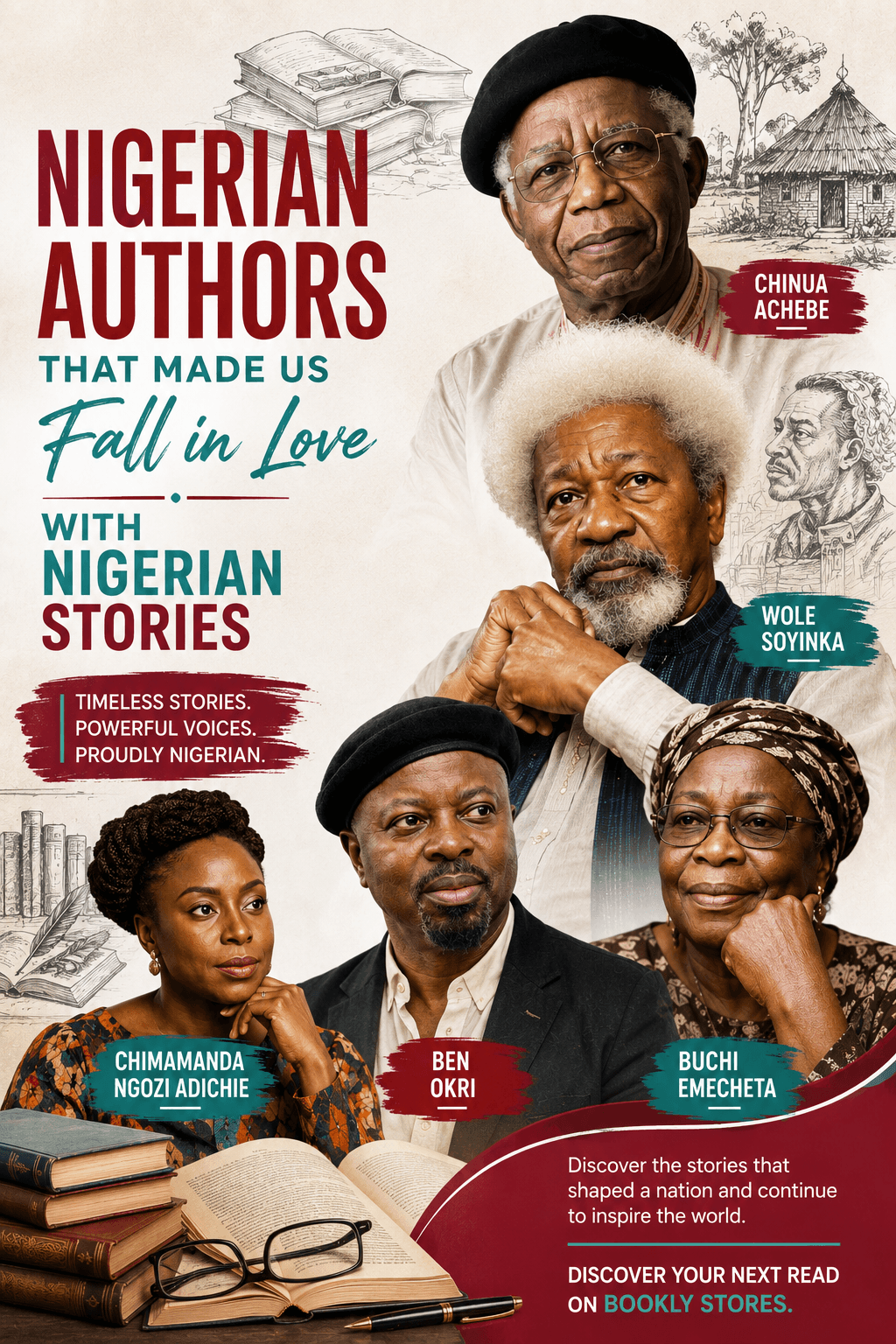
Here are five Nigerian authors who have helped make us fall in love with Nigerian stories.
1. Chinua Achebe
You cannot talk about Nigerian literature without mentioning Chinua Achebe.
His 1958 classic, Things Fall Apart, introduced millions of readers to pre-colonial Igbo society and the dramatic changes brought by colonialism. Through Okonkwo’s story, Achebe showed that African societies had rich cultures, traditions, systems and histories long before colonial narratives attempted to define them.
But Achebe’s impact goes beyond one book.
His writing challenged stereotypes about Africa and gave Nigerian experiences a powerful voice in global literature. No Longer at Ease and Arrow of God further explored the tensions between tradition, modernity and colonial influence.
Achebe did not simply tell Nigerian stories. He helped change who had the authority to tell them.
2. Wole Soyinka
Wole Soyinka is one of Nigeria’s most celebrated writers and the first African recipient of the Nobel Prize in Literature.
His work spans plays, poetry, novels and essays, often exploring power, politics, oppression, culture and human freedom.
Works such as The Lion and the Jewel demonstrate his ability to combine humour, tradition and social commentary, while his other writings reveal a much more serious engagement with political and social realities.
What makes Soyinka particularly remarkable is his willingness to use literature as more than entertainment. His writing has often been a way of questioning authority and confronting injustice.
For generations of Nigerian readers, Soyinka has shown that a writer can be both an artist and a voice for society.
3. Chimamanda Ngozi Adichie
If Achebe introduced many readers to Nigerian stories, Chimamanda Ngozi Adichie helped bring a new generation of Nigerian stories to the global stage.
Her novels have explored love, family, war, identity, migration, race and gender through characters whose experiences feel deeply personal and distinctly Nigerian.
Purple Hibiscus introduced readers to Kambili and her complicated family life, while Half of a Yellow Sun took readers into the Nigerian-Biafran War through the lives of several unforgettable characters.
Then came Americanah, a story about migration, identity, race and returning home.
One of Adichie’s greatest strengths is her ability to take experiences that might seem ordinary and turn them into stories that invite conversations far beyond Nigeria.
Her books remind us that Nigerian stories are not one-dimensional. They can be intimate, political, funny, painful, romantic and thought-provoking, all at once.
4. Ben Okri
Ben Okri takes Nigerian storytelling somewhere a little more magical.
Best known for The Famished Road, Okri blends reality, spirituality, mythology and imagination to create a world that feels both familiar and otherworldly.
His writing often explores poverty, politics, dreams, suffering and hope, but he does so through a distinctive style that refuses to fit neatly into one category.
Reading Okri can feel like stepping into a dream where the boundaries between the physical and spiritual worlds begin to disappear.
His work is a reminder that Nigerian storytelling doesn’t always have to be straightforward. There is room for mystery, symbolism, imagination and the supernatural too.
5. Buchi Emecheta
Buchi Emecheta gave powerful attention to experiences that were often overlooked: the lives, struggles and ambitions of African women.
Through novels such as The Joys of Motherhood and Second-Class Citizen, she explored motherhood, marriage, gender expectations, migration, independence and the difficult choices women sometimes have to make within society.
Her characters were not simply supporting figures in someone else’s story. They had dreams, frustrations, ambitions and voices of their own.
Emecheta’s work remains important because many of the questions she raised about womanhood, family and society continue to resonate with readers today.
Nigerian Stories, Global Impact
These writers showed the world how powerful Nigerian stories can be when told from within.
They wrote about different generations, different experiences and different aspects of Nigerian life. Yet their works share something important: they made readers curious about Nigeria, its people, its history and its many stories.
And perhaps that is one of the greatest gifts of literature.
A book can take you somewhere you’ve never been, introduce you to people you’ve never met and make you see your own world differently.
So, if you haven’t read any of these authors yet, perhaps it’s time to pick a Nigerian story and begin.